The SAS versus Python debate has become one of the defining conversations in the data science community. For decades, SAS was the undisputed leader in enterprise analytics. Today, Python has emerged as the dominant language for data science, machine learning, and AI. But how do they actually compare across the dimensions that matter most to working data scientists?
This article provides a thorough, objective comparison of SAS and Python across nine key areas: syntax, data handling, statistical capabilities, machine learning, visualization, scalability, community and ecosystem, cost, and enterprise support. Whether you are evaluating a migration or simply trying to understand the landscape, this guide gives you the facts you need.
1. Syntax and Learning Curve
SAS uses a procedural syntax organized around DATA steps and PROC (procedure) calls. Programs are written as a sequence of steps, each ending with a RUN; statement. The syntax is verbose but self-documenting, and SAS programmers can often read code written by others without extensive comments.
Python uses an object-oriented syntax with method chaining, list comprehensions, and a rich standard library. Code is generally more concise, but the flexibility means there are often multiple ways to accomplish the same task.
| Aspect | SAS | Python |
|---|---|---|
| Paradigm | Procedural, step-based | Object-oriented, multi-paradigm |
| Verbosity | High (explicit steps) | Low to moderate (concise) |
| Case sensitivity | Not case-sensitive | Case-sensitive |
| Statement terminator | Semicolon required | Line break (no semicolon) |
| Learning curve for beginners | Moderate | Moderate (easier with programming background) |
| Learning curve for analysts | Low (designed for analysts) | Moderate (general-purpose language) |
Verdict: SAS is easier for analysts with no programming background because it was designed specifically for data analysis. Python is more versatile and, once learned, enables a much wider range of tasks beyond analytics.

SAS to Python migration — automated end-to-end by MigryX
2. Data Handling
Data manipulation is the bread and butter of any analytics tool, and both SAS and Python are powerful in this area.
SAS handles data through the DATA step, which provides a row-by-row processing model with implicit looping. PROC SQL adds set-based operations. SAS datasets are stored in a proprietary format (SAS7BDAT) that handles large files efficiently through direct disk access.
Python's pandas library provides the DataFrame, a flexible in-memory data structure that supports vectorized operations, method chaining, and integration with dozens of file formats. For data that exceeds memory, PySpark and Dask extend the DataFrame paradigm to distributed computing.
| Operation | SAS | Python (pandas) |
|---|---|---|
| Read CSV | PROC IMPORT | pd.read_csv() |
| Filter rows | WHERE statement / IF | Boolean indexing / .query() |
| Create columns | Assignment in DATA step | df["col"] = expression |
| Group and aggregate | PROC MEANS / PROC SUMMARY | df.groupby().agg() |
| Join/merge | DATA step MERGE / PROC SQL JOIN | pd.merge() / df.join() |
| Reshape (wide to long) | PROC TRANSPOSE | pd.melt() / pd.pivot_table() |
| Sort | PROC SORT | df.sort_values() |
| Deduplication | PROC SORT NODUPKEY | df.drop_duplicates() |
Verdict: Both are highly capable. SAS's disk-based processing handles very large single-machine datasets well. Python's pandas is more flexible and concise for in-memory work, with PySpark providing a clear path to distributed processing for truly massive datasets.
MigryX: Purpose-Built for Enterprise SAS Migration
MigryX was designed from the ground up for enterprise SAS migration. Its SAS parser understands every construct — DATA steps, PROC SQL, PROC SORT, PROC MEANS, PROC FREQ, PROC TRANSPOSE, macros, formats, informats, hash objects, arrays, ODS output, and even SAS/STAT procedures like PROC REG and PROC LOGISTIC. This is not a generic code translator — it is the most comprehensive SAS migration platform in the industry.
3. Statistical Capabilities
This is where SAS has historically held its strongest advantage. SAS/STAT contains over 80 statistical procedures, many with options and output tables not available elsewhere. These procedures have been validated over decades and are trusted by regulatory bodies worldwide.
Python's statistical capabilities are distributed across multiple libraries: statsmodels for classical statistics, scipy.stats for hypothesis testing, scikit-learn for predictive modeling, and specialized packages like lifelines (survival analysis), linearmodels (panel data), and pingouin (ANOVA and post-hoc tests).
Statistical Procedure Mapping
The most commonly used SAS procedures all have Python equivalents:
- PROC REG / PROC GLM maps to
statsmodels.OLS/statsmodels.GLM - PROC LOGISTIC maps to
statsmodels.Logitorsklearn.LogisticRegression - PROC MIXED maps to
statsmodels.MixedLM - PROC PHREG maps to
lifelines.CoxPHFitter - PROC FACTOR maps to
sklearn.decomposition.FactorAnalysis - PROC CLUSTER maps to
sklearn.cluster
Verdict: SAS has broader coverage of specialized statistical procedures and deeper output options for classical statistics. Python covers the vast majority of common statistical needs and is stronger in modern machine learning. For most organizations, Python's statistical capabilities are more than sufficient.
4. Machine Learning and AI
This is where Python decisively surpasses SAS. The Python ecosystem is the center of gravity for machine learning and artificial intelligence research and practice.
SAS offers machine learning through SAS Enterprise Miner and SAS Viya's Visual Data Mining and Machine Learning. These tools provide a graphical interface and a curated set of algorithms, but they lag behind the open-source community in terms of algorithm breadth and cutting-edge techniques.
Python provides scikit-learn for traditional ML, TensorFlow and PyTorch for deep learning, XGBoost and LightGBM for gradient boosting, Hugging Face Transformers for NLP, and dozens of specialized libraries. Every major ML research paper published today includes Python code.
| ML Capability | SAS | Python |
|---|---|---|
| Classical ML (regression, trees, SVM) | Strong | Strong |
| Gradient boosting (XGBoost, LightGBM) | Limited | Industry standard |
| Deep learning | Basic (SAS DLPy) | Industry standard (PyTorch, TensorFlow) |
| Natural language processing | SAS Text Analytics | Extensive (Hugging Face, spaCy, NLTK) |
| Computer vision | Limited | Extensive (OpenCV, torchvision) |
| Reinforcement learning | Not available | Multiple frameworks |
| Time to adopt new techniques | Months to years | Days to weeks |
Verdict: Python is the clear winner for machine learning and AI. The gap is significant and growing, as virtually all ML innovation happens in the Python ecosystem first.
5. Visualization
SAS provides visualization through PROC SGPLOT, PROC SGPANEL, and ODS Graphics for static reports, and SAS Visual Analytics for interactive dashboards. The output is polished and suitable for enterprise reporting.
Python offers a layered visualization ecosystem: matplotlib for fine-grained control, seaborn for statistical graphics, plotly for interactive charts, Altair for declarative visualization, and Streamlit or Dash for building data applications. The range of options can be overwhelming for beginners but provides unmatched flexibility.
Verdict: SAS produces clean, consistent graphics with less code for standard business charts. Python offers far more variety, interactivity, and customization. For web-based and interactive visualizations, Python is significantly stronger.
6. Scalability
SAS scales through SAS Grid Computing, which distributes SAS jobs across multiple servers. SAS Viya adds a cloud-native architecture with in-memory processing. However, scaling SAS is expensive because it requires additional SAS licenses for each server node.
Python scales through open-source distributed computing frameworks. PySpark on Apache Spark can process petabytes of data across hundreds of nodes. Dask provides parallel computing that scales pandas-like operations. Cloud platforms like Databricks, Snowflake (via Snowpark), and AWS SageMaker provide managed, elastic compute for Python workloads.
Verdict: Python's scalability options are more diverse, more cost-effective, and better integrated with cloud-native architectures. SAS Grid is capable but expensive and less flexible.
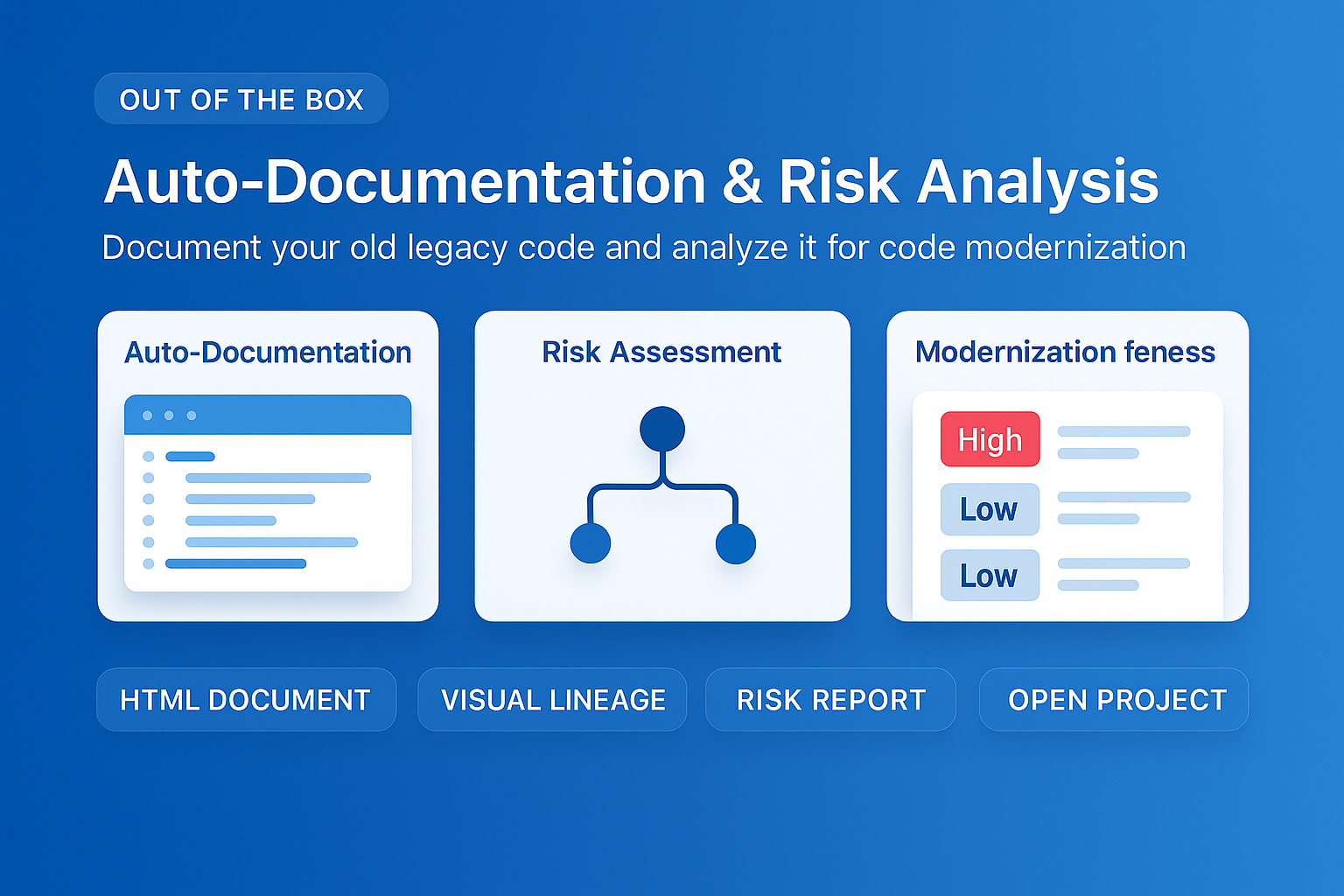
MigryX auto-documentation captures every transformation decision, creating audit-ready migration records automatically
How MigryX Handles the Hard Parts of SAS Migration
Every SAS shop has code that makes migration teams nervous — deeply nested macros that generate dynamic code, DATA step merge logic with complex BY-group processing, hash object lookups, RETAIN statements that carry state across rows, and PROC IML matrix operations. These are exactly the constructs where MigryX excels. Its combination of deterministic AST parsing and Merlin AI means even the most complex SAS patterns are converted accurately.
7. Community and Ecosystem
The size and activity of a tool's community directly affects how quickly you can find answers, solve problems, and adopt new techniques.
| Metric | SAS | Python |
|---|---|---|
| Stack Overflow questions | ~45,000 | ~2,200,000 |
| GitHub repositories | ~3,000 | ~1,200,000 (data science related) |
| Annual conference attendees | ~5,000 (SAS Global Forum) | ~15,000+ (PyCon + PyData combined) |
| Online courses (Coursera/edX) | ~20 | ~500+ |
| Published packages/libraries | ~200 (SAS products) | ~500,000+ (PyPI) |
Verdict: Python's community is orders of magnitude larger. This translates to faster problem resolution, more learning resources, and a much broader ecosystem of tools and integrations.
8. Cost
This comparison is straightforward but profound in its implications.
SAS is commercial software with annual subscription licensing. Costs scale with the number of users, products, and data volumes. A full enterprise deployment can cost millions annually.
Python is free and open-source under a permissive license. All major data science libraries (pandas, scikit-learn, TensorFlow, PySpark) are also free. Costs come from infrastructure (cloud compute, storage) and people (salaries), not software licensing.
Verdict: Python eliminates software licensing costs entirely. Even accounting for cloud infrastructure and potentially higher headcount during transition, the total cost of ownership for Python-based analytics is typically 60-80% lower than SAS over a five-year period.
9. Enterprise Support and Governance
This is the area where SAS retains meaningful advantages, though the gap is narrowing.
SAS provides a single vendor for support, with dedicated account teams, 24/7 technical support, and a long track record in regulated industries. SAS code is deterministic and reproducible, and SAS Institute provides formal validation documentation for statistical procedures.
Python's support model is distributed. Organizations rely on a combination of community support, paid enterprise support from platform vendors (Databricks, Anaconda, Snowflake), and internal expertise. Governance tools like MLflow, Great Expectations, and Apache Airflow provide workflow management, data quality, and model tracking.
| Enterprise Need | SAS Solution | Python Ecosystem Solution |
|---|---|---|
| Technical support | SAS Institute (single vendor) | Platform vendor + community |
| Code governance | SAS Management Console | Git + CI/CD pipelines |
| Job scheduling | SAS Flow Manager | Apache Airflow / Prefect |
| Model management | SAS Model Manager | MLflow / Weights & Biases |
| Data quality | SAS Data Quality | Great Expectations / dbt tests |
| Regulatory validation | SAS validation docs | Custom validation + open-source testing |
Verdict: SAS offers a more cohesive enterprise support experience from a single vendor. Python requires assembling a support ecosystem from multiple sources, but the components are mature, widely adopted, and often provide better functionality than their SAS equivalents. The single-vendor advantage of SAS comes at significant cost and reduces flexibility.
The Bottom Line
There is no single right answer for every organization. SAS remains a solid choice for teams deeply embedded in regulated industries who need guaranteed vendor support and have existing investments in SAS infrastructure. But the trend lines are clear.
Python wins on cost, machine learning capabilities, community size, scalability, and integration with modern cloud platforms. SAS holds advantages in specialized statistical depth and single-vendor enterprise support. For most organizations evaluating their analytics strategy in 2026, Python represents the future, and the question is not whether to adopt it, but how to make the transition efficiently.
The strongest analytics teams in the coming decade will not be defined by which tool they use, but by how effectively they leverage the strengths of their chosen platform. For a growing majority, that platform is Python.
Whatever your current position on the SAS-to-Python spectrum, understanding the strengths and trade-offs of each tool empowers you to make informed decisions about your analytics future.
Why Every SAS Migration Needs MigryX
The challenges described throughout this article are exactly what MigryX was built to solve. Here is how MigryX transforms this process:
- Complete SAS coverage: MigryX handles every SAS construct — DATA steps, PROC SQL, macros, formats, hash objects, arrays, ODS, and 20+ PROCs.
- 4-8x faster than manual: What takes consulting teams months of manual conversion, MigryX accomplishes in weeks with higher accuracy.
- 60-85% cost reduction: Enterprises report dramatic cost savings compared to manual migration approaches.
- Production-ready output: MigryX generates clean, idiomatic Python, PySpark, Snowpark, or SQL — not rough drafts that need extensive rework.
MigryX combines precision AST parsing with Merlin AI to deliver 99% accurate, production-ready migration — turning what used to be a multi-year manual effort into a streamlined, validated process. See it in action.
Ready to modernize your legacy code?
See how MigryX automates migration with precision, speed, and trust.
Schedule a Demo